

On November 3, 2026, Todyl published an investigation into a campaign it calls Key Eater, and it updated that write-up on November 6. One operator has been signing in to Microsoft Entra ID and Azure as the victims' own applications, using client secrets and other app credentials that were still valid. Todyl first saw the activity on November 1. Microsoft, in research published November 5, says it saw successful service principal sign-ins from the same main address as early as October 28. As of Todyl's November 3 update, it counted about 45 app registrations targeted at roughly 18 organizations, more than 33 successful authentications, and 27 organizations reached, most of them MSPs and the client tenants they manage. Huntress posted the same afternoon that it was seeing malicious service principal sign-ins from the same IP address in four of its customer tenants.
No Microsoft vulnerability is involved, so there's no CVE and nothing to patch. That's a big part of why I wanted to write this one up. Controls like MFA and user-scoped Conditional Access protect user sign-ins. For much of this campaign, the attacker authenticated as an application instead, so those controls didn't apply.
I covered app-only access in my earlier post on the ConnectWise Cloud Backup (SkyKick) compromise. That campaign ran through a single vendor's multi-tenant app. Todyl assesses Key Eater as unrelated: the credentials belong to the victims' own apps, the infrastructure is different, no persistence was observed, and there's no meaningful overlap with the SkyKick-affected tenants. So this post is less about one vendor and more about where app secrets end up living, and what happens when somebody collects enough of them.
What has been reported
Unless I say otherwise, everything below comes from Todyl's write-up and its updates through November 6. Times are UTC.
- Oct 28: Microsoft reports its earliest successful service principal sign-ins from 199.19.77[.]84, involving multiple application IDs.
- Nov 1, 08:45: Todyl's first sighting: access with a stolen app credential from 199.19.77[.]84, a hosting address on AS203662 geolocated to Poland.
- Nov 1, 14:39: An Azure DevOps federated workload identity is used from the same address.
- Nov 2, 10:39: First replay of a user's Azure DevOps session token.
- Nov 2, 17:40: First Microsoft Graph search inside a victim tenant.
- Nov 2, 20:36: Bulk file downloads from SharePoint begin, at about one file per second.
- Nov 3, 07:56: A single MSP multi-tenant app sweeps 15 client tenants in roughly 10-second loops. A minute later, after detections fired, the actor switches from curl and Python to spoofed browser user agents.
- Nov 3, 15:16: Last successful action Todyl saw, app-only downloads at one MSP.
- Nov 3, 18:12: Several users' refresh tokens are replayed with scripted clients. Conditional Access blocks all of them.
- Nov 3, 21:31: Latest attempt in Todyl's November 3 update, another blocked token replay.
- Nov 5–6: Microsoft publishes its research on agentic tooling that hunts for exposed secrets, and Todyl updates its root-cause assessment.
As of November 3, Todyl's totals were about 25 tenants searched, 81 files downloaded and around 2,279 mailbox items accessed. It's careful to say those numbers are a floor, because they only cover organizations that send logs to Todyl.
Where the secrets came from
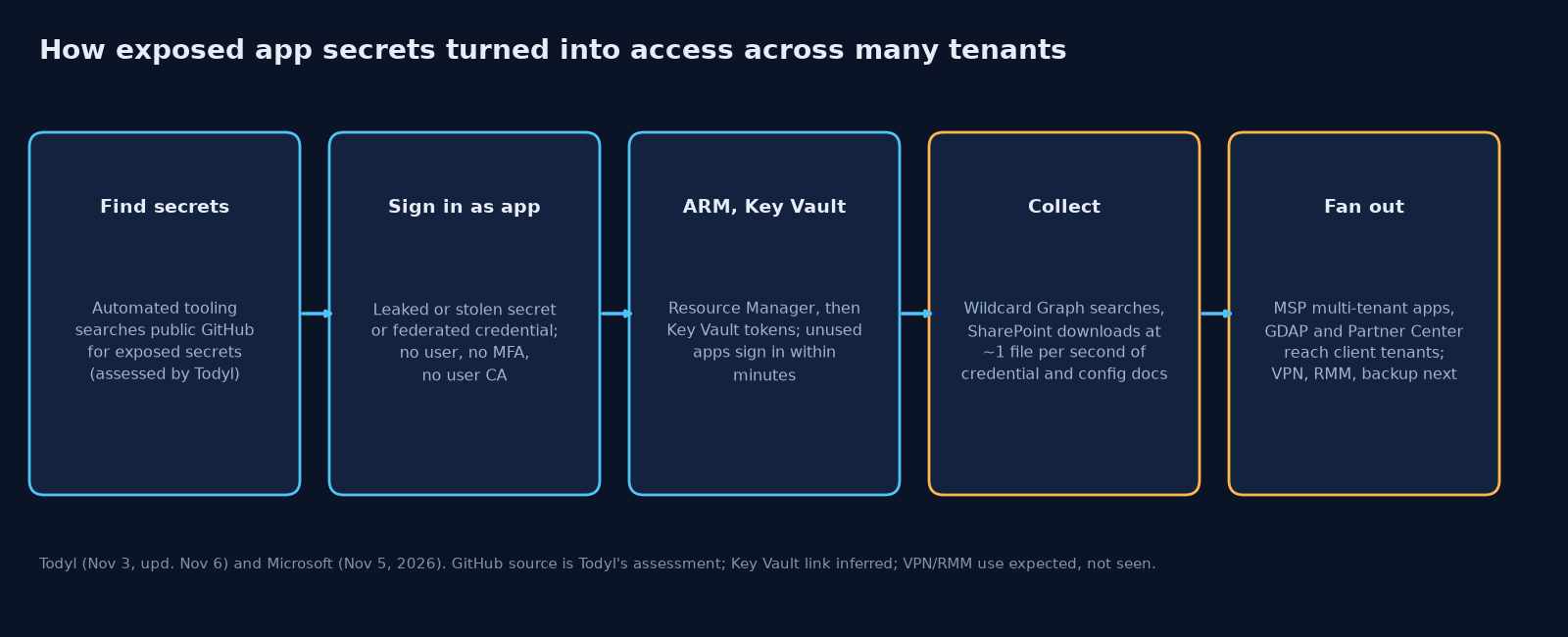
Todyl's first view was that the source was unknown, possibly a file store or a backend system. Its November 6 update changes that. Todyl now assesses the activity as an automated, agentic credential crawler: tooling that finds exposed secrets, signs in with them and acts on what it collects with little human direction. Its reasons are scanning from the actor's address in the days before the first sign-in, no sign of earlier cloud or endpoint compromise, and the fact that many of the affected apps are custom-built, which makes secrets exposed in public repositories or web apps the likely source.
Microsoft's research describes threat actors using an agentic AI offensive framework, with ARTEX named as an example of that kind of tooling, to search public GitHub repositories for exposed secrets starting in August 2026. In one case Microsoft saw an agent go from scanning GitHub to taking data out of Azure Key Vault in five minutes. Microsoft separately describes follow-on activity from 199.19.77[.]84 using "valid leaked or stolen application credentials" and notes that Todyl reported a similar campaign involving the same IP addresses. Microsoft doesn't say that every credential in this campaign came from GitHub, so I'd read the GitHub link as Todyl's assessment backed by Microsoft's wider research rather than something proven for every victim.
Todyl's November 3 update had listed the tampered Claude Code extension in the Cursor marketplace as a possible source. That theory isn't part of its current assessment.
Why it moved so fast
Todyl's headline is that the campaign moves like a worm without being one, and I think that's the right read. Nothing is jumping between MSPs on its own. One source works through a stockpile of secrets, and inside each MSP family it uses whatever it just harvested to sign in as more apps within minutes. In one case it downloaded a connector archive and signed in as that connector's app about two and a half minutes later.
The order of operations is consistent. For nearly every credential, the actor requests an Azure Resource Manager token, then a Key Vault token, and often Graph, Storage and Cognitive Services tokens within seconds of that. Shortly afterwards, apps in the same tenant that had never been used before start authenticating. Todyl says the timing points to Key Vault reads as one source of the new credentials, while noting that Key Vault audit logs are needed to prove it. Microsoft reports Key Vault secret theft in the cases it investigated.
Then comes collection. The actor runs Graph searches with a single wildcard and pulls files from SharePoint at about one per second, picking names that look like credentials or configuration: password lists, private keys, VPN profiles, MFA and RMM API keys, backup-storage credentials, firewall and RDP configs, Azure inventories and service-account maps. That list matters a lot to anyone doing MDR. Todyl expects those files to be used against VPNs, MFA services, RMM platforms, backup storage and network devices, and none of that would show up in Microsoft 365 logs.
Scripted clients made 95% of the sign-ins, with bursts of up to 24 sign-ins in 10 seconds and fixed retry loops of about 11 seconds. On November 3, Todyl read the multi-hour idle gaps and the switch to browser user agents as a person steering the tooling, and held AI involvement at low confidence. By November 6, Todyl and Microsoft were both describing agentic tooling that needs little hands-on-keyboard direction. Todyl also saw four AI-service tokens issued (three Cognitive Services, one Azure ML) and later reported one partner billed thousands of dollars in AI usage in about 10 minutes, so AI service keys are clearly part of the target.
Why the usual controls didn't apply
When an app signs in with a client secret, there's no user and no MFA prompt. User-scoped Conditional Access policies don't evaluate it. Your own network firewall usually won't see it either, because the sign-in goes from the attacker's server straight to Microsoft. If the secret is valid, the app gets a token with whatever permissions it was already granted.
Microsoft does offer Conditional Access for workload identities, and it's the right tool to block a known-bad address for service principals. It has limits that people tend to discover in the middle of an incident, though. It needs a Workload ID Premium license. It only covers single-tenant service principals registered in your own tenant, so multi-tenant apps, third-party SaaS apps and managed identities are out of scope. And a policy assigned to a group that contains a service principal isn't enforced for that service principal; it has to be assigned directly. Todyl and Microsoft both pair a workload identity policy with a user-scoped block for replayed sessions, and Todyl adds putting Key Vault and Storage behind network restrictions so a valid token from an unknown address can't reach the data anyway.
What I'd look at first
None of this needs a specific tool. These are the behaviours I'd check in Entra service principal and non-interactive sign-in logs, plus Azure DevOps audit, Key Vault and Storage diagnostics. Todyl and Microsoft both say to search back to at least October 28, or as far as retention allows. Entra Free only keeps seven days of sign-in logs, so on that tier the earliest activity may already be gone; export what you still have now.
- Failed secrets. A failed client-secret sign-in for an app (Entra error AADSTS7000215 for an invalid secret, or AADSTS7000222 for an expired one) from an address you don't recognise is a sign that someone outside holds, or is trying, a credential for it. Todyl and Microsoft treat a failure followed within minutes by a success for the same app from the same address as urgent.
- One address, many apps. A single source authenticating as several service principals in a tenant, or across unrelated tenants within a day, with a mix of failures and successes.
- Resource Manager, then Key Vault, then new apps. A token for Resource Manager followed right away by a Key Vault token for the same app, and then apps that have never signed in before starting to authenticate.
- Machine-speed downloads. App-only SharePoint downloads from non-Microsoft addresses at around one file per second, especially right after a wildcard search and focused on file names about credentials or configuration.
- Retries against dead credentials. Regular retry loops against apps that were already disabled or rotated. Todyl says the actor kept doing this, which tells me rotation is necessary but doesn't end the incident by itself.
- Token replay from hosting providers. Several users' refresh tokens presented from hosting addresses by Python or curl clients within a few minutes.
- Azure CLI password grants. Sign-ins to the Azure CLI public client (04b07795-8ddb-461a-bbee-02f9e1bf7b46) using the resource owner password grant from hosting providers. Todyl links a password spray like that to the operator with only low to moderate confidence.
Detection logic that only fires on successful sign-ins misses the first and last items on that list. I'd treat a failed service principal sign-in from a hosting provider as a lead worth an analyst's time, because a legitimate workload rarely gets its own secret wrong from somewhere it has never been.
Indicators
These are as published by Todyl and Microsoft through November 6, 2026.
| Type Value Notes | ||
| IPv4 | 199.19.77[.]84 | Operator. All of Todyl's confirmed app sign-ins, downloads and token replays; Microsoft saw sign-ins from it from Oct 28. High confidence |
| IPv4 | 199.19.77[.]18 | Azure CLI password spray and FortiGate probing (Todyl, low to moderate confidence link). Microsoft also saw sign-ins from it but notes it is a Tor exit node, so expect unrelated noise |
| IPv4 | 65.87.223[.]26 | Azure CLI spray, Oct 4 to 27 (Todyl); App Service token attempts and shell commands in a user agent (Microsoft) |
| IPv4 | 157.22.126[.]128 | Reconnaissance of Azure AI workloads (Microsoft) |
| IPv4 range | 199.19.77[.]0/24 | Contains the operator and spray addresses. Todyl's Nov 6 update recommends blocking it |
| User agent | task177-f2267/1.0 | Unique to the actor per Todyl |
| User agent | sait-tenant-deep/37346 | Unique to the actor per Todyl |
| Not actor infrastructure | 20.20.34[.]96, 20.20.34[.]160, 20.231.130[.]224 | Microsoft service addresses where the actor's searches and mail reads get logged. Don't block these |
The blocking advice differs between the two sources. Microsoft's November 5 guidance says to block 199.19.77[.]84/32 rather than the whole ASN. Todyl's November 6 update goes further and recommends blocking 199.19.77[.]0/24 plus 65.87.223[.]26. Neither recommends blocking the whole ASN. Whichever you choose, an IP block only lasts until the operator moves, and Microsoft notes this kind of tooling changes source addresses and user agents, so the behaviours above matter more than the list.
If you get a hit
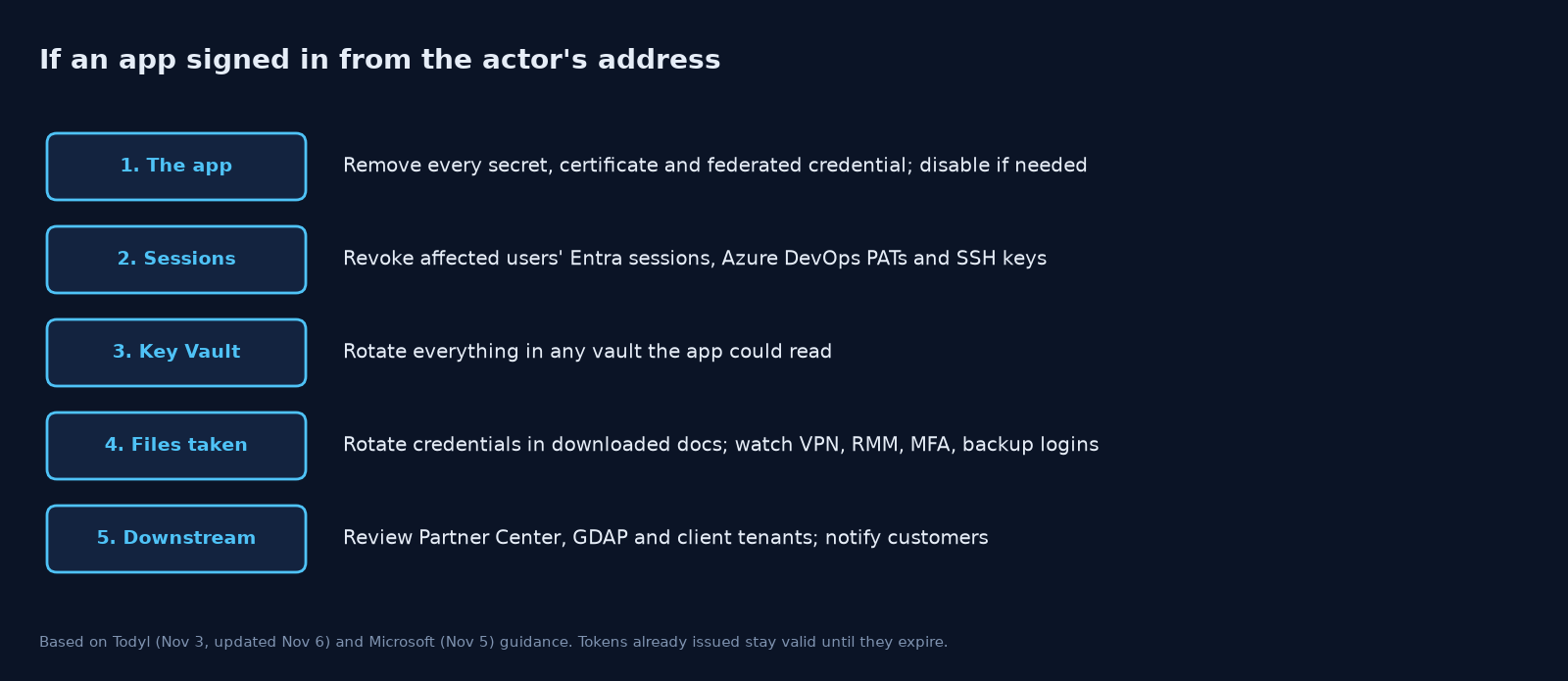
Todyl's and Microsoft's containment guidance is to remove all secrets, certificates and federated credentials on the affected app, including any you didn't add, and disable the service principal if you have to. Both note that tokens already issued remain valid until they expire, so removing the secret doesn't instantly cut off a session that's already running. For any affected users, revoke Entra sessions, Azure DevOps personal access tokens and SSH keys. Revoking sessions stops refresh tokens from being used again, but it doesn't recall an access token that's already been handed out, which is another reason to block the source address and put data behind network restrictions.
The step I think gets skipped is the downstream one. If the app could read a Key Vault, everything in that vault has to be rotated, including any AI service keys, and their usage and billing should be checked. If the actor downloaded a VPN profile or an RMM API key from SharePoint, that credential is exposed even though it has nothing to do with Entra. I'd raise monitoring on VPN, RMM, MFA and backup logins for that customer right away and assume someone will try those credentials. For MSPs, the scope also includes Partner Center tokens, GDAP relationships and every client tenant a compromised multi-tenant app could reach, with notifications going out under whatever your agreements require. And if a secret turns up in a public repository, deleting the file isn't enough: Microsoft is clear that the credential stays usable until it's rotated.
ATT&CK mapping
| Tactic Technique Behaviour (observed unless noted) | ||
| Reconnaissance | T1593.003 Search Open Websites/Domains: Code Repositories | GitHub searches for exposed secrets (Microsoft's research; Todyl assesses this as the source here) |
| Initial Access | T1078.004 Valid Accounts: Cloud Accounts | App sign-ins with leaked or stolen client secrets and an Azure DevOps federated credential |
| Initial Access | T1199 Trusted Relationship | MSP multi-tenant and GDAP apps and Partner Center tokens used to reach client tenants |
| Defense Evasion | T1550.001 Application Access Token | Resource Manager, Key Vault, Graph and Storage tokens issued to app identities |
| Defense Evasion | T1550.004 Web Session Cookie | Replayed Azure DevOps user session token |
| Credential Access | T1555.006 Cloud Secrets Management Stores | Key Vault token requests followed by sign-ins as unused apps (inferred by Todyl); Key Vault secret theft reported by Microsoft |
| Credential Access | T1552.001 Credentials in Files | SharePoint downloads focused on credential and configuration documents |
| Discovery | T1580 Cloud Infrastructure Discovery | Resource Manager enumeration for each credential |
| Collection | T1530 Data from Cloud Storage | 81 files downloaded from SharePoint (as of Nov 3) |
| Collection | T1114.002 Remote Email Collection | Around 2,279 mailbox items accessed (as of Nov 3) |
What I'm taking from this
The first thing is that app secrets need the same inventory and lifecycle we give user accounts, and they often don't get it. Old apps nobody owns can still have long-lived secrets, and the secret itself can end up in a repository, a runbook, a wiki page or an RMM note. Microsoft's advice is to treat any secret that has been publicly exposed as compromised and rotate it, even if the file was deleted. Todyl's hardening advice is to retire client secrets where you can, preferring managed identities, then workload identity federation, then certificates held in a vault, and to use app management policies to block new secrets and cap their lifetimes. I agree with all of it. Todyl also points out that federation moves the trust to whatever system issues the tokens, which in this case was Azure DevOps, and that was abused too. I think that's the part teams are most likely to forget once the secrets are gone.
The second is about MSP documentation. A lot of MSPs keep client credentials in SharePoint because it's convenient, and this campaign went looking for exactly those files. If an attacker can read your documentation library, they likely have credentials for many of the systems it describes. I'd much rather see those credentials in a proper vault with access logging than in a spreadsheet called passwords.
The third is speed. If tooling can go from a public secret to Key Vault in minutes, the time to catch a leaked secret is before it's pushed, not after.
References
- Todyl, "Stolen App Credentials, Real Access: An Actor Is Signing Into Entra ID and Azure DevOps as Your Workloads" (Nov 3, 2026, updated Nov 6, 2026): https://www.todyl.com/blog/stolen-app-credentials-real-access-an-actor-is-signing-into-entra-id-and-azure-devops-as-your-workloads
- Microsoft Threat Intelligence and Microsoft Security Research, "Threat actors use agentic AI tooling to find and abuse exposed secrets" (Nov 5, 2026): https://www.microsoft.com/en-us/security/blog/2026/11/05/threat-actors-use-agentic-ai-tooling-to-find-and-abuse-exposed-secrets/
- Huntress on X, independent confirmation of malicious service principal sign-ins from 199.19.77[.]84 (Nov 3, 2026): https://x.com/HuntressLabs/status/2117731517304902092
- Todyl, investigation into unauthorized access through the ConnectWise Cloud Backup Microsoft 365 app (Oct 2026): https://www.todyl.com/blog/investigation-unauthorized-access-through-the-connectwise-cloud-backup-microsoft-365-app
- Microsoft Learn, "Microsoft Entra Conditional Access for workload identities": https://learn.microsoft.com/en-us/entra/identity/conditional-access/workload-identity
- Microsoft Learn, "user: revokeSignInSessions" (Microsoft Graph): https://learn.microsoft.com/en-us/graph/api/user-revokesigninsessions
- GBHackers, "Hackers Use Stolen Microsoft Entra ID App Credentials to Breach 27 Organizations and Steal Sensitive Data" (Nov 4, 2026): https://gbhackers.com/hackers-use-stolen-microsoft-entra-id-app-credentials/
- MITRE ATT&CK, T1593.003 Code Repositories: https://attack.mitre.org/techniques/T1593/003/
- MITRE ATT&CK, T1550.001 Application Access Token: https://attack.mitre.org/techniques/T1550/001/
- MITRE ATT&CK, T1555.006 Cloud Secrets Management Stores: https://attack.mitre.org/techniques/T1555/006/